

Watching a loved one grow older is a profound emotional journey. It becomes especially difficult when you realise they can no longer manage daily life safely on their own but when you suggest getting a little extra help, they push back completely.
Dealing with elderly parents who refuse help is one of the most common and stressful situations UK families face in eldercare. If you’re currently arguing with your mother or father about hiring a professional carer, or wondering whether they should move into a care home at all, you are not alone. Many adult children feel lost, guilty, and overwhelmed when a parent refuses assistance.
This guide covers why parents say no, how to talk to them without triggering a row, what to do if they refuse a care home rather than home care, what social services can and can’t do, and importantly what you are and aren’t legally responsible for as their child.
Note: this guide focuses on the law and system in England. Wales, Scotland, and Northern Ireland have separate (though broadly similar) legislation see the note near the end.
Why elderly parents refuse home care

Understanding the root cause of your parents’ resistance is the first step to finding a solution. People rarely refuse help just to be difficult their refusal is usually rooted in deep emotional fears about ageing.
A Deep Fear of Losing Independence
For an older adult, their home represents their freedom the place where they raised a family, made their own rules, and lived life on their own terms. Admitting they need a professional to help them cook or bathe feels like surrendering that independence.
Fear of the Unknown
Bringing a stranger into their personal space feels invasive. They may have outdated ideas about what a carer actually does, assuming someone will come in and take over their entire life.
Denial About Their Condition
It’s hard for anyone to admit their body or mind is failing. Many elderly people genuinely don’t realise how much danger they’re in they might blame a fall on a slippery rug rather than their failing balance.
Trust Issues with Strangers
Inviting someone new into a private home requires trust. Your parent might worry about theft, poor treatment, or simply not getting along with the carer.
Signs your elderly parent needs help

Even if your parents insist they’re fine, their environment and physical appearance often tell a different story.
- Forgetting medication overflowing pillboxes, missed or doubled-up doses
- Frequent falls or unexplained bruises or changes in how they move around furniture
- Poor personal hygiene dirty clothes, avoiding the shower or bath
- Unexplained confusion or memory loss missed appointments, getting lost, leaving the stove on
- A messy or unsafe home unopened mail, rotting food, a filthy bathroom
What to do when your parent refuses care

Forcing the issue will only make them dig in deeper. A strategic, compassionate approach works far better.
Communication Tips
Don’t tell them what they must do ask how they’re feeling and listen. Use “I” statements: “I worry about you when I’m at work, and having someone check in would give me peace of mind,” rather than “You keep falling, you need a babysitter.” Plant the idea over several weeks rather than demanding an immediate decision.
Family involvement
Get siblings on the same page before approaching your parents, so they don’t receive mixed messages. Sometimes a parent will listen to a family doctor, a social worker, or a religious leader more readily than their own children.
Gradual Introduction
Don’t hire a full-time carer immediately. Start small light housecleaning or gardening once a week, framed as a treat rather than medical care. Once they’re used to a friendly face in the house, it becomes far easier to introduce personal care or meal preparation later.
What if your parent refuses personal care specifically?
Refusing help with personal care bathing, dressing, toileting, continence is a different, more sensitive issue than refusing help with cleaning or shopping. It touches directly on dignity and privacy, so resistance here is often stronger and more emotional than resistance to housekeeping help.
A few things that genuinely help:
- Same-gender carer requests. Most agencies will try to match a carer’s gender to the client’s preference on request this alone resolves a large share of personal-care refusals.
- Let them keep control of small choices. What order tasks happen in, which products are used, what time of day handing back small decisions restores some of the dignity that “being cared for” can feel like it takes away.
- Separate the person from the task. Introduce the carer first for something non-intimate (a cup of tea, a chat) so trust builds before personal care is even mentioned.
- Involve a GP or district nurse. If a parent is refusing personal care to the point of skin breakdown, infection, or incontinence-related health risk, a health professional flagging it as a medical necessity (rather than a lifestyle suggestion) often lands differently than a family member raising it.
If a parent has the mental capacity to decide, they are legally entitled to refuse personal care even if you or professionals disagree with the decision see the mental capacity section below.
Can social services help in the UK?

If family conversations aren’t enough, you can turn to official support.
If you believe your parent could benefit from support, you or your parent can request a Care Needs Assessment from their local council. This is a free assessment (regardless of the parent’s finances) carried out by a social worker or occupational therapist, who evaluates physical and mental capability and identifies what support would help.
How to contact social services for an assessment:
- Find your parent’s local authority via the gov.uk council finder.
- Call or email that council’s adult social care team directly and ask for a Care Needs Assessment.
- Alternatively, ask your parent’s GP to make a referral, or use the NHS’s signposting service for adult social care.
- If your parent lacks capacity to request it themselves, you can request the assessment on their behalf as a concerned relative the council still has a duty to consider it.
Parents are often far more willing to accept help when a doctor or social worker recommends it as a medical necessity, rather than hearing it from a family member.
Reporting a safeguarding concern (different from a Needs Assessment)
A Needs Assessment and a safeguarding referral are not the same thing, and it’s worth knowing the difference:
- Needs Assessment used when someone (the parent, or a relative on their behalf) is asking the council to assess what support would help. This is the right route if your parent is simply struggling but not in immediate danger.
- Safeguarding referral used when there’s a genuine risk of abuse, neglect, exploitation, or self-neglect that’s putting an adult at risk of harm. Anyone a neighbour, a family member, a carer can raise this, and you don’t need the person’s permission to do so.
To report a safeguarding concern about an elderly person:
- Contact the adult social care team at their local council and ask specifically to make a safeguarding referral (this is usually a distinct phone line or form from general enquiries).
- If you believe they’re in immediate danger, call the police (999) or, for non-emergencies, 101.
- The council has a legal duty under Section 42 of the Care Act 2014 to make enquiries whenever there’s reasonable cause to suspect an adult with care and support needs is at risk of abuse or neglect and is unable to protect themselves regardless of whether that adult wants the referral made.
What powers do social services actually have over an elderly person?
This is one of the most misunderstood parts of eldercare, so it’s worth being precise:
- Assessment and support powers. The council must carry out a Needs Assessment where someone appears to need care and support, and must meet eligible needs (subject to a financial means test for funding, though the assessment itself is always free).
- Safeguarding enquiries. Under Section 42 of the Care Act 2014, the council must investigate credible safeguarding concerns and can coordinate a protection plan involving the police, NHS, and other agencies.
- Mental capacity assessments. If there’s doubt about whether someone can understand, weigh up, and communicate a decision about their own care, a professional can carry out a Mental Capacity Assessment under the Mental Capacity Act 2005.
- Best Interests Decisions. If someone is found to lack capacity for a specific decision, professionals must make a decision in their best interests this can include arranging care or, in the most serious cases, a move into residential care, even without full family agreement, if it’s genuinely necessary for the person’s safety and wellbeing.
- What they cannot do. If your parent has the mental capacity to understand the risks and make the decision, social services cannot force them to accept care, adaptations, or a move into a care home even if their choice worries the whole family and even if professionals think it’s a bad decision. Capacity, not the wisdom of the choice, is the legal test.
Am I legally required to care for my elderly parent in the UK?

No. There is no legal obligation on adult children in the UK to provide personal care for a parent, nor to fund their care from your own pocket. Filial responsibility laws exist in some other countries but not in the UK.
What does exist:
- The local authority has a duty to assess your parent’s needs and, where eligible, arrange or fund support this duty sits with the council, not with you.
- If you choose to provide informal care, you’re entitled to your own Carer’s Assessment from the council, which can lead to support and services for you (respite care, Carer’s Allowance if you meet the criteria, etc.).
- You can decline to provide hands-on care at any point without legal consequence — though obviously this is an emotional decision as much as a legal one, and stepping back doesn’t remove your parent’s right to be assessed and supported by the council.
If guilt is a big part of what’s driving this question, it may help to know that “I can’t do this alone” is not a legal failing it’s exactly the situation a Needs Assessment and Carer’s Assessment exist for.
What if your parent refuses to move into a care home?
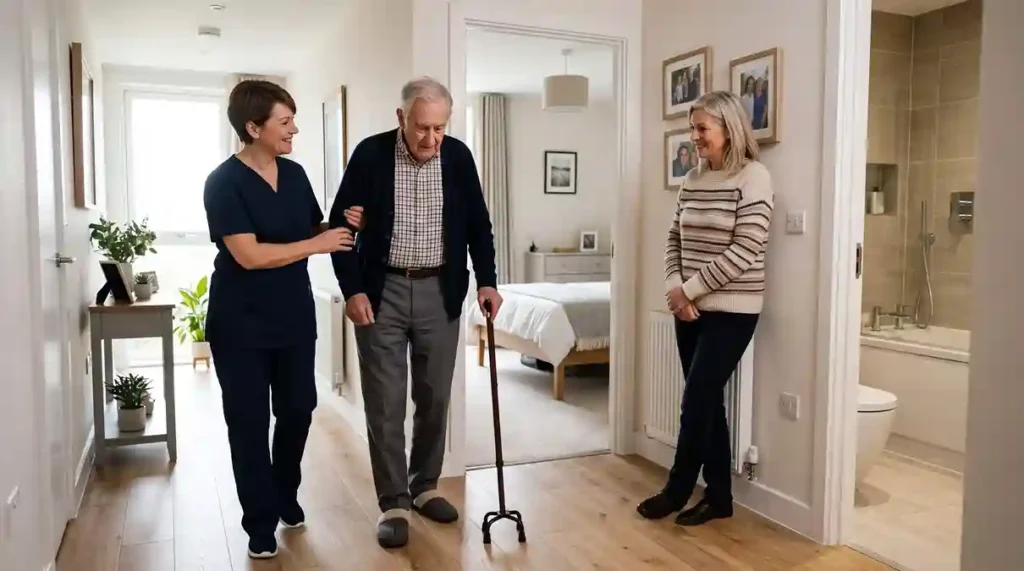
Refusing home care (a carer visiting the house) and refusing to move into a care home are different situations, and the second is usually higher-stakes it involves leaving their home, their community, and often their independence in one go, which is why resistance tends to be much stronger.
If your parent has mental capacity
they have the legal right to refuse to move into a care home, full stop even if you, their doctors, or a hospital discharge team strongly disagree, and even if staying at home is genuinely risky. Capacity, not risk level, is what determines whether they can be overruled.
Hospital discharge pressure.
A common flashpoint is a hospital wanting to discharge a parent into residential care after a fall or illness, while the parent refuses to go. Hospitals cannot force a capacitated adult into a care home to free up a bed. You can ask for a discharge to assess process instead, where your parent goes home (or to a short-term “step-down” placement) with support while a fuller assessment of long-term needs happens this is standard NHS practice and worth explicitly requesting.
If your parent lacks mental capacity
for this specific decision (for example, due to advanced dementia), a Best Interests Decision can be made under the Mental Capacity Act 2005, which may include moving them into residential care against their stated wishes, if that’s genuinely judged to be in their best interests and less restrictive options have been ruled out. This decision must involve family consultation and, in more serious or contested cases, may go through the Court of Protection. An Independent Mental Capacity Advocate (IMCA) is appointed if they have no one else to represent their views.
In practice, before it gets to that point:
- Try a trial stay many care homes offer a short respite stay so a parent can experience it without committing, which often reduces fear of the unknown.
- Bring in a social worker or GP to reframe the conversation as being about safety rather than “giving up” independence.
- If safety is the core concern, ask whether a heavily increased package of home care (including live-in care) could realistically meet the same needs sometimes the care-home conversation is really a home-care conversation that hasn’t been fully explored yet.
Is home care better than a care home?
Home care preserves independence.
Your parent stays in the environment they love their pets, garden, and neighbours and keeps control over their daily routine. Visits can be tailored from a 30-minute check-in to full live-in support.
Care homes offer full-time supervision.
This is often necessary if medical needs can no longer be managed safely at home. But it means downsizing possessions, leaving the community, and adapting to a structured, institutional schedule.
For most families, exploring a well-matched home care package is the sensible first step before considering a permanent residential move but where medical or safety needs are severe and constant, a care home may genuinely be the safer option, and it’s worth being honest with yourself about that rather than delaying out of guilt.
When professional home care becomes necessary
Gentle persuasion has its limits. Recognise when the situation has crossed from stubbornness into genuine danger:
- Severe safety risks leaving the gas on, wandering at night, repeated falls with no way to get up
- Rapid health decline unexplained weight loss, untreated infections, refusing life-saving medication
- Complete family burnout if caring for your parent is damaging your own health, relationship, or mental wellbeing, that’s a sign to bring in outside help, not a failure on your part
A note on the rest of the UK
The Care Act 2014 and the sections above on assessments, safeguarding, and social services powers apply to England. Wales has its own equivalent under the Social Services and Well-being (Wales) Act 2014; Scotland operates under the Adults with Incapacity (Scotland) Act 2000 and separate social work legislation; Northern Ireland has its own health and social care trust system. The general principles no forced care while someone has capacity, a right to request an assessment, distinct safeguarding routes are broadly similar across all four nations, but exact processes and contact points differ.
Frequently Asked Questions (FAQs)
What should I do if my elderly parents refuse care?
Listen to their fears without arguing, validate what they’re feeling, and introduce help gradually starting with non-medical tasks like housekeeping. Frame it as something that helps you worry less, not something they’re being forced into because they’re failing.
Can I refuse to care for my elderly parent in the UK?
Yes. There’s no legal duty on adult children in the UK to provide care for a parent or to fund it. The legal duty to assess and arrange support sits with the local council. You’re entitled to your own Carer’s Assessment if you do provide informal care.
Can social services force home care in the UK?
No — not if your parent has the mental capacity to make their own decisions. If they’re diagnosed with a condition affecting capacity (such as advanced dementia) and are found to lack capacity for the specific decision, social services can act under the Mental Capacity Act 2005 to arrange care in their best interests.
What powers do social services have over the elderly?
They can carry out Needs Assessments, run safeguarding enquiries under Section 42 of the Care Act 2014, assess mental capacity, and make Best Interests Decisions where someone lacks capacity including, in serious cases, arranging residential care. They cannot override a capacitated adult’s decision to refuse care.
How do I report concerns about an elderly person to social services?
Contact the adult social care team at their local council and ask specifically for a safeguarding referral if you suspect abuse, neglect, or self-neglect this is separate from a general Needs Assessment request. If there’s immediate danger, call 999, or 101 for non-emergencies.
My parent refuses to move into a care home what can I do?
If they have mental capacity, they have the legal right to refuse, even after a hospital stay. Ask about a “discharge to assess” process rather than immediate residential placement, consider a trial respite stay to reduce fear of the unknown, and involve a GP or social worker to reframe the conversation. If capacity is genuinely in question, a formal Mental Capacity Assessment and, if needed, a Best Interests Decision process can be started.
What are the signs that an elderly parent cannot live alone?
Repeated falls, unexplained weight loss, poor hygiene, missed medications, a cluttered or filthy home, and wandering behaviour. If they can no longer safely cook, bathe, or use the bathroom, they need support.
How much does home care cost in the UK?
Visiting carers typically charge £20–£30 per hour. Live-in care generally costs £1,000–£2,000 per week, depending on region and complexity of need.
How to apply for home help in the UK?
Contact your local council to request a free Care Needs Assessment. If eligible, the council will help arrange and potentially fund support. You can also contact private agencies directly for self-funded care.